Killing Cancer

A narrated patient story · Prepared for Secretary Robert F. Kennedy Jr. and the Chief of Policy

Killing
Cancer

Six lives. One immune system. Not another drug.

Chemotherapy poisons the cancer and the patient with it. What these six people received is different: a signal, IL-15, that tells the body to make more of the cells that already kill cancer. One was treated under the single FDA approval Anktiva holds, for bladder cancer, granted in 2024. The other five, including Beth, were treated in trials or under expanded access, for uses the FDA has not approved. All six are here to tell you what happened, in their own words, with the full interviews embedded in this file.

Approved for one cancer, April 2024Not approved for anything else in this film71% complete response, bladder CIS6 patients, 6 cancers
Read it instead
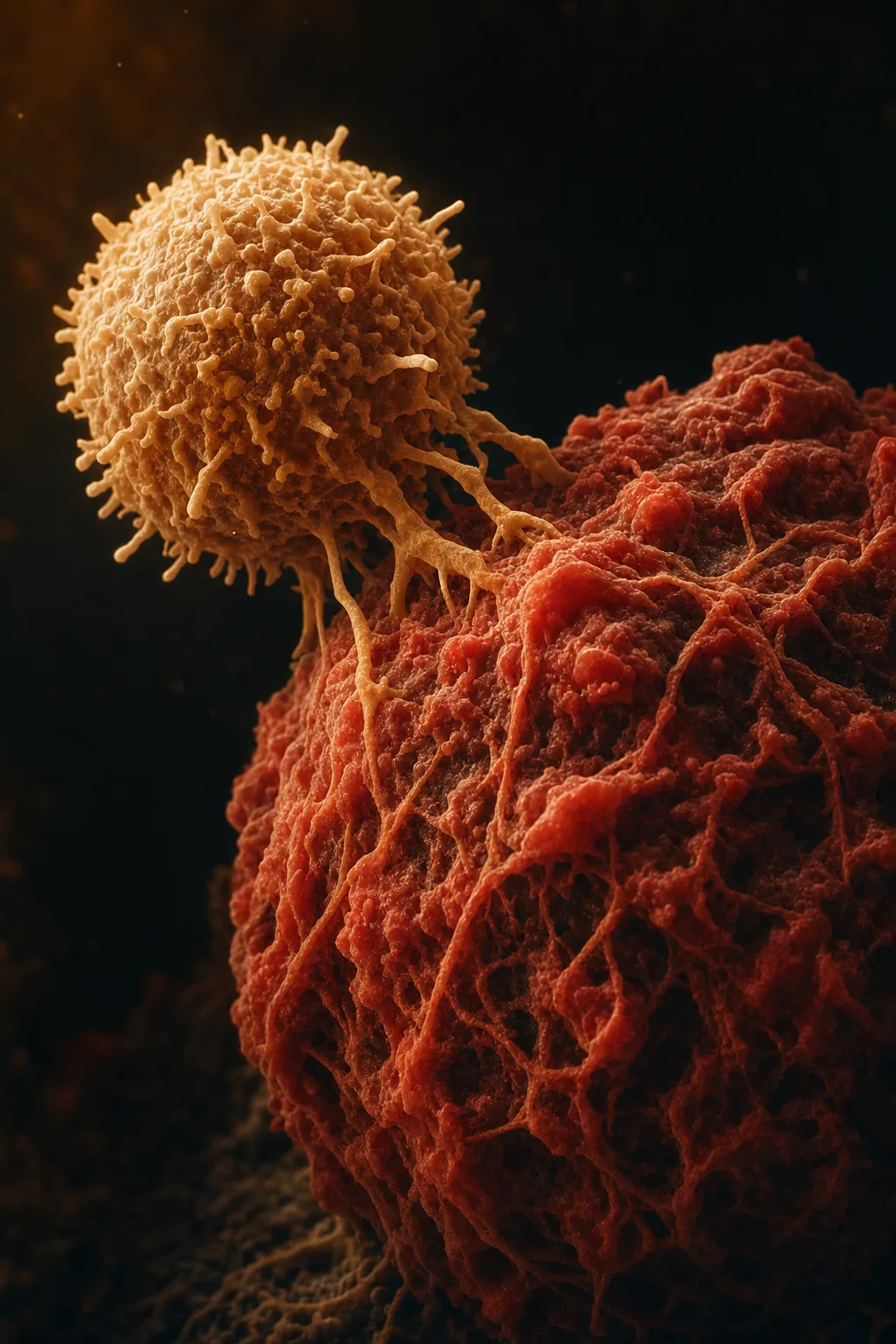
A natural killer immune cell reaching toward a cancer cell, rendered as warm amber and crimson macro photography
Why this is different

Every cancer drug you have been shown attacks the tumor. This one rebuilds the patient.

The staff briefing version, in three points. Every number links to its source.

01

It is a signal, not a poison

Anktiva is an IL-15 receptor agonist. In the FDA's own review, binding to the IL-15 receptor "results in proliferation and activation of NK, CD8+, and memory T cells without proliferation of immuno-suppressive regulatory T cells" (FDA multidisciplinary review). Chemotherapy kills dividing cells indiscriminately; the immune cells are collateral damage. This does the opposite. Beth's lymphocyte count of 525 is what chemotherapy leaves behind. Her count of 1,400 after one injection is what an IL-15 signal does.

02

Approved for one cancer, and the responses last

The FDA approved Anktiva with BCG on April 22, 2024 for BCG-unresponsive bladder cancer with carcinoma in situ, the situation where the next step is removing the bladder (FDA). In the label population, 62% had a complete response; 58% of those responses lasted at least 12 months and 40% at least 24 (FDA). In the full 100-patient cohort presented at AUA 2025, the complete response rate was 71%, median duration of response 45.4 months, 84% of responders still had their bladder at 36 months, and disease-specific survival at 36 months was 99% (ImmunityBio, AUA 2025). Justin is one of those patients. For every other use on this page, lymphopenia, glioblastoma, pancreatic, lung, prostate and Long COVID, Anktiva is not FDA-approved. That gap is what this presentation is about.

03

One mechanism. Every cancer in this film.

Bladder. Multiple myeloma. Metastatic lung. Glioblastoma. Recurrent prostate. Stage 3 colon. Six different diseases, one target: the patient's own natural killer and T cells. That is why the FDA granted Expanded Access in June 2025 for Anktiva to treat lymphopenia in adults with any relapsed or refractory solid tumor whose lymphocyte count is below 1,000 (ImmunityBio), and Regenerative Medicine Advanced Therapy designation in February 2025 for reversing chemotherapy- and radiation-induced lymphopenia (ImmunityBio). A drug treats a tumor. This treats the system that is supposed to.

Cold open

The sentence that stops time

Black screen. Five quick cuts, each patient's first line, no music.

  • “I had an annual physical. They found something in the urine.”
  • “I was the last patient of the day, and he said, "You have multiple myeloma."”
  • “I was alone when I got my results. It was stage four. And I had like 24 tumors in my body.”
  • “They did a CAT scan and said, "Look, you have a major mass on the brain, and we need to remove it immediately."”
  • “After six weeks of that surgery, my cancer was back.”
Narrator

Every one of these people heard the sentence that stops time. A physical. A blood test. A scan after a fall. And every one of them was told, in one way or another, what the standard of care could and could not do for them.

This is not a story about a drug. It is a story about the immune system — the one weapon against cancer that every human being is born with — and about six people who were given a way to switch it back on.

These are their words.

Chapter 1

Justin

Bladder cancer · Syracuse, New York

Treated under the FDA approval

A husband, a father, an outdoorsman, and a man who does not like to waste time. Bladder cancer runs in his family. When a routine physical found something, he already knew what the word might be.

Full interview, 7:30, embedded in this file. Click any timecode to play that clip; the player pauses at the clip's end. Original on Vimeo

Narrator

Justin is a husband, a father, an outdoorsman, and a man who does not like to waste time. Bladder cancer runs in his family — his grandfather, his father, his uncle. So when a routine physical turned up something in his urine, he already knew what the word might be.

Justin
I had an annual physical. They found something in the urine. Being that my uncle had bladder cancer, and my father had bladder cancer, and my grandfather had bladder cancer, they said we should just be careful and take a look, and they found out it was.
Justin
Our first set of doctors were taking the path that it might be better, because of my age, to just have the bladder removed.
Justin's urologist
He's engaged with his family. He's an outdoorsman. So, having a bag, or even having a neobladder we'd have to catheterize, just would be really devastating to his quality of life.
Justin and physician
We started initially with BCG. I had some not so great responses to just BCG alone. Hated it. — He was having symptoms. He was having bleeding, and all that, of course, fed to his anxiety that maybe the cancer has come back.
Narrator

In early 2024 the cancer returned. The next step on the standard path was removing his bladder. Then, in the very month Justin needed a new option, one arrived. Anktiva had just been approved by the FDA for exactly his situation — bladder cancer that BCG alone could no longer control.

Justin
I just happened to be in the right place at the right time, because I needed to find another treatment that wasn't BCG, and Anktiva became available literally the month that I was ready to start.
Physician
He was our first patient within central New York, one of the first people in the country to get the medicine commercially.
Physician
How Anktiva works is to make the tumors go from cold to hot, and then the immune system is a powerful tool to then scavenge those cancer cells and keep them at bay. And then the immune system learns from that behavior.
Justin
It gave me almost like a supercharged feeling, where I was back working out with a power. I was golfing the next day. Didn't affect any of my professional business trips.
Physician
Never had an ill side effect or complication we usually would have with BCG, and there's not been any recurrence of disease or progression of disease, and that's where we are right now.
Justin
I'm one of those people that turns a problem into an opportunity.
Justin
It just forces me to find what really matters and focus on that. I've got a great family. We're active. We just try to enjoy time, honestly, together as a family. Worrying's not one of the things I want to do with my time.
Narrator

Justin still has his bladder. He still has his golf game. And his physician, a surgeon who performs cystectomies for a living, now has something else to offer patients before he reaches for the knife.

Chapter 2

Lisa

Multiple myeloma · Actress, model, television host

NK-cell clinical trial

She has spent her career under lights and knows how to look well. For years she used that skill to hide the fact that she was not.

Full interview, 8:11, embedded in this file. Click any timecode to play that clip; the player pauses at the clip's end. Original on Vimeo

Narrator

Lisa has spent her career under lights — acting, modeling, hosting television. She knows how to look well. For years, she used that skill to hide the fact that she was not.

Lisa
I've spent my professional career getting dolled up, standing under lights, getting to know my best angles. Some call me an actress, model, TV host, writer, poet, professional nomad.
Lisa
You know something is wrong, something is just not right, but I just kept going. I had the appointment, and I was the last patient of the day, and he said, 'You have multiple myeloma.' And he said, 'Whatever you do, don't Google it.' So of course, I Googled it. That was the first thing that happened when I went home, and it was terrifying.
Lisa
I have cancer. I'm living with a condition called multiple myeloma, which is a blood cancer, and the experts say that I am in complete remission, CR, but multiple myeloma is considered incurable. In my mind, in my heart, I believe I'm cured because I've already relapsed once, but it's not going to happen again.
Narrator

Multiple myeloma is called incurable. Lisa relapsed in 2012, right after her wedding. She did everything she could find — diet, detoxes, yoga — all of it aimed at one idea: that her own immune system was the thing that had to win. Then she joined a clinical trial of natural killer cells, and for the first time, she felt science was on her side.

Lisa
It's strange because I always feel a little nervous. Sort of your future hinges on that blood test. But when I'm sitting here in the hospital is when I realize what I'm living with.
Lisa
Everybody's body creates cancer cells every single day, and it just so happens that our immune system shuts it down. That's the work of the soldiers in our immune system, all the cells, the T-cells, and the NK cells, and everything like that. And then NK92 happened.
Lisa
I was like, 'Oh my God, finally, science is getting behind this.' He sent me a video of cancer cells being destroyed by NK cells, and they're just picking them out.
Dr. Reese and Lisa
This remission on the pills has gone beyond the expectation without the NK cells. — One of the drugs I'm on is supposed to have 25 different side effects. I don't have a single one.
Dr. Reese
I think what will probably revolutionize the care is immune treatment. There are a whole spectrum of immune treatments that you know. You have one. The field is looking at immune treatments that try to rev up someone's own NK cells. I think it's going to revolutionize treatment.
Lisa
We've been waiting for the cusp of something like this. I'm sorry. It's good news. It's really good news. I feel like now finding my optimism is being validated by the science.
Lisa
Immunotherapy is about partnering with your body and helping your body do what it's meant to do. I almost want to shake people on the street and say, 'Do you know how close we are? Come on, everyone. Let's band together. Let's make this happen.' And I'm saying it out of selfish reasons. It's my own life I'm fighting for.
Lisa
So today, when I put on the makeup, I always make sure, and I remind myself that I can spread my message, even if it's just showing up and looking good. Because I'm living with cancer, that's a statement in itself. That's a form of activism.
Narrator

Lisa still shows up under the lights. The difference now is that she tells people why.

Chapter 3

Valerie

Metastatic lung cancer · Grandmother

Clinical trial: Keytruda + N-803

Standard treatment worked for two and a half years. She rang the bell. Then, alone in a room in June 2022, she heard the words stage four.

Full interview, 3:51, embedded in this file. Click any timecode to play that clip; the player pauses at the clip's end. Original on Vimeo

Narrator

In 2019, Valerie was diagnosed with lung cancer. Standard treatment worked — for two and a half years. She rang the bell. She believed it was over. Then, in June of 2022, she sat alone in a room and heard the words "stage four."

Valerie
2019 is when I found out that I had lung cancer. For two and a half years, my standard of care, it worked. I got to ring the bell. I was like, 'This is done.' But unfortunately, it wasn't done.
Valerie
Mid-June 2022, I went and got a CT scan. I was alone when I got my results that it was stage four. And I had like 24 tumors in my body, my left and right lung, on my thyroid, and on a rib. So, this opened up a chance for me to get into a clinical trial and do something different.
Valerie
At that point, I was really, really sick. I wasn't able to walk. I couldn't breathe. I had to sit up to sleep at night because my doctor had said, 'You have six to eight weeks to live if we don't do this.' I didn't hear that.
Narrator

Twenty-four tumors. Six to eight weeks. Valerie entered a clinical trial combining chemotherapy, the checkpoint inhibitor Keytruda, and N-803 — the molecule now known as Anktiva. Her first scan came two months later.

Valerie
My first CT scan was October 25th. So, Dr. Lu, he was blown away because it was 75% to 80% improved in just two months. He called me his miracle patient, and he said, 'I have never seen anything like this.' Like, 'Okay. Then let's just keep going. Let's do this.' My faith was always stronger than my fear.
Valerie
But it's a tough thing to go through, chemotherapy just killing everything. After treatment, I would be in bed for a week. The positive thing was I was there with my granddaughter. She woke me up every morning to show me what she was wearing to school.
Valerie
Right at the end of 2022, I just said, 'I can't do this anymore. We need to stop the chemotherapy.' In January of 2023, when I had the first treatment, when I just had the Keytruda and the N-803, I was able to eat. I wasn't weak. So, the quality of life was so much better with just the two. It's almost like I immediately felt better, and my scans were improving and improving.
Valerie
I started walking. I joined a gym, enjoying my granddaughter. That fall, I ran the whole Harvest Festival. So, I was able to do life again.
Valerie
My last scan that I had, it showed that there's not any tumors in my right lung, just my left lung, but the ones in my left lung have shrunk. On my thyroid, it's gone.
Valerie
It's helped me to really want to live life. It's a miracle to go from having six to eight weeks to live three and a half years ago, to still be here.
Narrator

Three and a half years after being given six to eight weeks, Valerie is still getting her granddaughter off to school.

Chapter 4

Andrew

Glioblastoma · Touring production professional

Investigational: Anktiva after standard chemo and radiation

Nearly forty years on the road with the biggest bands in the world. Then a collapse in his own living room, a scan, and the grimmest diagnosis in oncology.

Full interview, 4:33, embedded in this file. Click any timecode to play that clip; the player pauses at the clip's end. Original on Vimeo

Narrator

Andrew spent nearly forty years on the road with the biggest bands in the world. He met his wife on a U2 tour. Last year, in his own living room, he collapsed. The scan showed a mass on his brain. The diagnosis was glioblastoma — the cancer with perhaps the grimmest prognosis in all of oncology.

Andrew
I've been in the entertainment industry over 35, nearly 40 years. I've toured with pretty much every major band you could think of. Met my wife while I was on U2, and yeah, I had a change in direction very quickly last year.
Andrew
I actually collapsed in this living area, and because I took a fall, they did a CAT scan and said, 'Look, you have a major mass on the brain, and we need to remove it immediately.' Did an amazing job, got rid of the tumor.
Andrew
My wife had already had a discussion with the doctor. Terminal disease prognosis generally isn't good. You may get 12 to 18 months if you're lucky, sort of discussion. I'm not the sort of person to just take something lying down. I'm a very positive individual.
Narrator

Twelve to eighteen months, if he was lucky. Andrew went home, opened his phone, and came across an interview with Dr. Patrick Soon-Shiong. The idea he heard was simple: use the tumor itself as the vaccine, and teach the immune system to remember it.

Andrew, then Dr. Soon-Shiong
When I got home and came across my feed, Patrick Soon with Tucker Carlson. — You need to have the natural killer cells and T cells ready. You can use the tumor in your body to act as the weapon, as the vaccine, because the tumor has molecules that is foreign to the rest of your body, and if you educate your T cells to recognize those molecules that is foreign to the rest of your body, that T cell can remember.
Andrew
His methodology and the way he's approached this, for me, made the most sense. I still went through the standard regimen of chemo and radiation. I was lucky because I did start the Anktiva in December. I had an MRI scan January 13th, came back clean. Where they removed the tumor from my brain, my brain matter filled it back in. My oncologist at Cedars-Sinai said he's never seen that at that sort of level. Yeah, my last scan came back clean, so that was good.
Andrew and clinician
Not getting the tumor reoccurrence is what's been my focus. This is my seventh injection now. — Yeah, today's your seventh. — So seventh injection of Anktiva.
Andrew
What you get with Anktiva when you first take it is you'll just get the fatigue. For me, day six is generally the hardest time of it, but I will say day seven, I feel amazing.
Andrew
The oncologist at Cedars-Sinai told me, said, 'You know what? I'm very excited that you're willing to pioneer or try these different treatments.'
Andrew
I want to beat glioblastoma. I want to be able to say that it's not a death sentence. You can still have a quality of life. Geez, if I get six, seven, eight more years, that's great. We want my journey, our journey, to be of benefit to other people, so people have hope, they have a better option, a better outcome, and I'm willing to do whatever it's going to take to accomplish that.
Narrator

Andrew's scans are clean. He counts his injections the way he used to count tour dates. And he is asking for something modest: a few more years, and a chance for his story to matter to the next person.

Chapter 5

Alan

Recurrent prostate cancer · Entrepreneur

Investigational: Anktiva + adenovirus PSA vaccine before radiation

Seven stable years under surveillance. Then COVID, a doubling PSA, collapsing lymphocytes, surgery, and six weeks later the cancer was back. His chapter introduces the four-dollar blood test.

Full interview, 11:27, embedded in this file. Click any timecode to play that clip; the player pauses at the clip's end. Original on Vimeo

Narrator

Alan was diagnosed with prostate cancer in 2015 and lived under surveillance for seven stable years. Then came COVID. Within a month, his PSA nearly doubled — and, he would later learn, his lymphocytes were collapsing at the same time. Surgery followed. Six weeks later, the cancer was back.

Alan
2015, I was diagnosed with prostate cancer, Gleason 7. It was after I had COVID in 2022 that within a month, my PSA, that was in surveillance and stable for seven years, increased. It almost doubled. Later, I found out that my lymphocytes were dropping drastically at the same time that my PSA went up.
Alan
I was told that I needed to do a radical prostatectomy, and that was November of '23. After six weeks of that surgery, my cancer was back, not expressed as a tumor, but as cancerous cells that are still circulating in the area. Within three months, my PSA started increasing rapidly at about 20% a month.
Alan
They immediately recommended radiation therapy, and also hormone therapy, androgen deprivation therapy, for which I replied, 'I'm not going to do the hormone therapy, but I am okay with just doing the radiation.' I did ask, 'How about immunotherapy?' And the comment was that there was nothing really available.
Alan
I was on a Sunday praying for something that will help me to get through this, and the first thing I thought was, 'Why don't I text Patrick and ask him if he has something for me?' Within seconds, I see a reply from him, and he said, 'I do. Let's get on a Zoom call later today.'
Dr. Soon-Shiong
He was very grateful that I'd called him so quickly, but I said, 'Alan, this is what I do. Patients need help. I'm there.'
Narrator

What Dr. Soon-Shiong told Alan next is the idea at the center of this entire film. Radiation kills cancer — but it also wipes out the lymphocytes, the natural killer cells and T cells that are the body's own defense. And for decades, oncology has barely looked at them.

Dr. Soon-Shiong
They radiate the prostate bed, but they wipe out all the lymphocytes. And by the way, they don't come back for 12 months. Before you get radiation, we give you Anktiva, which would actually protect the lymphocytes or the ALC. The Anktiva was already approved for bladder cancer, but more importantly, we'd given over 8,000 doses subcutaneously. And all of this is an outpatient, two jabs.
Dr. Soon-Shiong
Every oncologist had looked at just neutrophils to define when someone went on therapy, and forgot to look at the lymphocyte. Those patients who have low are more likely to not respond to their therapy, more likely to die. The bottom line is a simple test that Medicare pays about $4 for. A complete blood count with differential, which are done in automated machines in hospitals every single day, can give us a guide. But up until Anktiva, there was nothing to treat them.
Alan, then Dr. Soon-Shiong
My PSA at the time I received the first shot was at 0.2, and within five days at UCSD, prior to the radiation, it already dropped by 20% just from the immunotherapy. Immediately at UCSD, they started looking at me like, 'Well, this is going to be an interesting patient.' — His doctors were so incredulous. They said they'd never seen this happen.
Alan
The top doctor at University of Michigan said to me, 'Thank you.' And I was, 'Why?' And he said, 'Thank you for volunteering for something like this because you have the potential of impacting millions of lives.' That was a great motivator.
Alan
Within 10 weeks, my PSA dropped by 70%. I received another shot of the immunotherapy. Within 10 days of that shot, my PSA went to undetectable levels. And I said to Patrick, 'I'm done.'
Alan
And he said, 'No. We're going to give you two more shots because now we're building your memory T cells. These cells are going to stay in your body. If this ever comes back, they're going to remember, and they're going to kill it.' So decided to go for the memory T cells, and here I am, completely undetectable PSA.
Dr. Soon-Shiong
We now have, for the first time, a treatment of the immune system, not just the disease, and the immune system takes care of that disease. That's why we saw this rapid drop in PSA.
Alan
My oncologists at UCSD and the radiation oncologists, they said, 'We don't like to say that the cancer is cured. We say remission, but we think you beat it.' I lost the sense of fear. So now I believe that everything can be fixed. And here I am.
Narrator

A four-dollar blood test. A number almost no one was watching. Alan's story raised a question that the next story answers: what happens to a patient whose lymphocytes never come back?

Chapter 6

Beth Kompothecras

Stage 3 colon cancer · chemotherapy-induced lymphopenia · Age 65 · wife, mother, grandmother

Clinical trial: Anktiva at the Chan Soon-Shiong Institute for Medicine

COVID in 2020. A clean colonoscopy in 2021. A hemoglobin of 2.5 after a family ski trip in 2023. Stage 3 colon cancer, surgery, six rounds of chemotherapy — and then an immune system that would not come back. Told in her own voice.

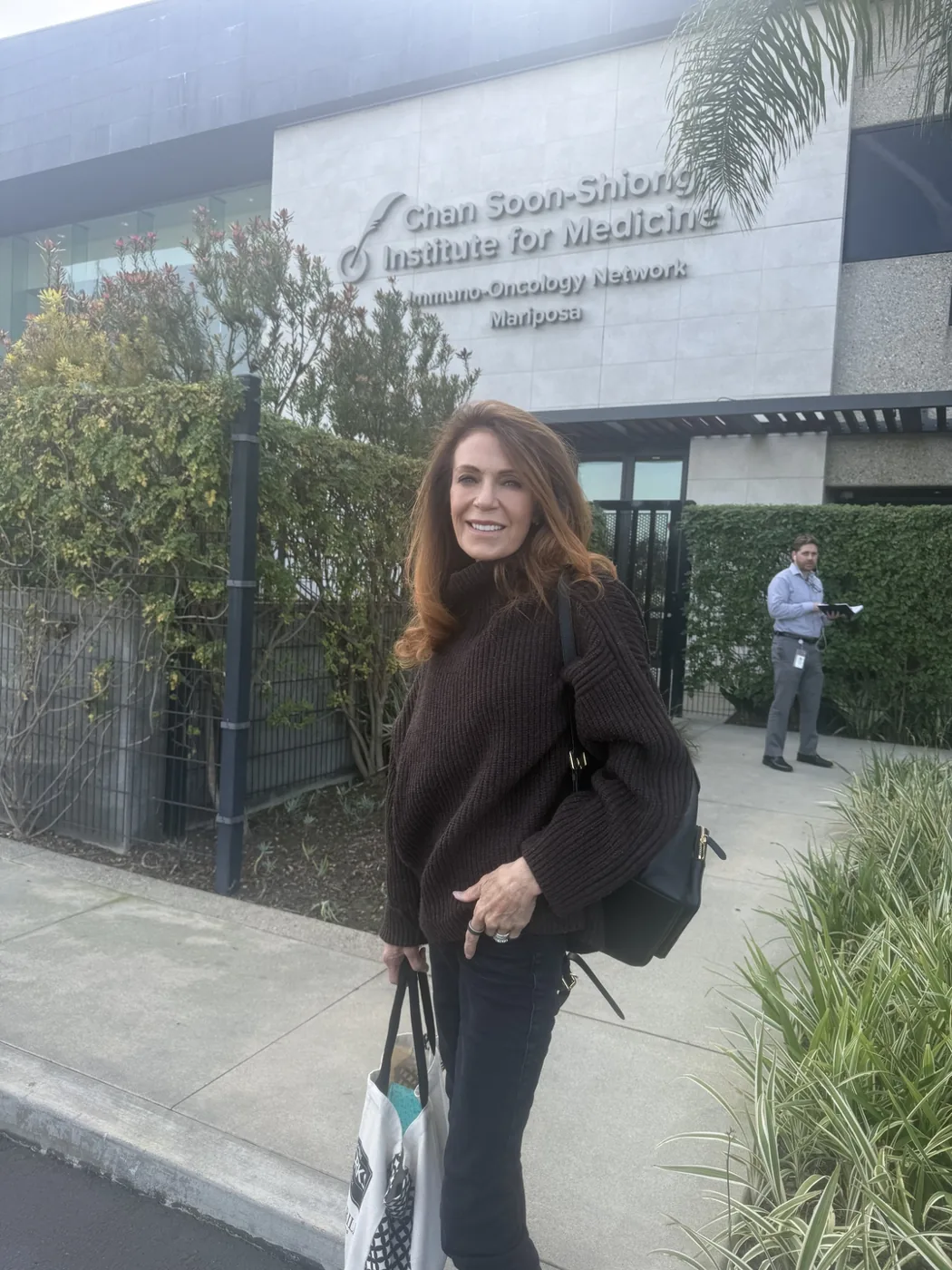
Beth Kompothecras smiling outside the Chan Soon-Shiong Institute for Medicine, Immuno-Oncology Network, El Segundo, California
Beth outside the Chan Soon-Shiong Institute for Medicine, California, 2026. Family photograph.

Beth's timeline

  1. 2020Full-blown COVID-19.
  2. 2021Routine screening colonoscopy. No evidence of disease.
  3. March 2023Hospitalized after a family ski trip. Hemoglobin 2.5, severely anemic. Two transfusions, four bags of iron. Endoscopy finds nothing. Discharged.
  4. April 2023Follow-up bloodwork: hemoglobin below 7.
  5. April 25, 2023Colonoscopy finds Stage 3 colon cancer.
  6. May 1, 2023Colon resection: 24 inches of colon and 44 lymph nodes removed. One node positive.
  7. June 1 – Sept 1, 2023Six rounds of FOLFOX (oxaliplatin-based) chemotherapy.
  8. Oct 2023 – Jan 2026Integrative and functional medicine: IVs, hyperbaric oxygen, sauna, frequency and red-light therapy daily, supplements, juicing, no-sugar diet. Total lymphocytes fall to 525.
  9. Early 2026Sees Dr. Patrick Soon-Shiong interviewed by Tucker Carlson and tells her husband, Dr. Gary Kompothecras. Through his relationships in the Trump administration and with Secretary Kennedy, he finds a way to get her enrolled.
  10. February 2026Enrolled in a Long COVID trial at the Chan Soon-Shiong Institute for Medicine, California. Ten Anktiva injections over 20 weeks.
  11. After first injectionLymphocytes rise from 525 to 1,400.
  12. July 20, 2026Lymphocytes level off between 1,100 and 1,200 and hold.
Beth's total lymphocyte count (cells per microliter), from her records
normal range (850–3,900)4008001,2001,600 5251,4001,131Sept 2023chemo endsJan 2026before the trialFeb 2026after first injectionJuly 2026after ten injections
Narrator

Beth is sixty-five. She is a wife, a mother, a grandmother — the kind of woman who organizes the family ski trip and is the first one on the mountain in the morning. In 2021 she did what she was supposed to do: a routine colonoscopy at the recommended age. It was clean. No evidence of disease. Two years later, that clean result would nearly cost her her life.

Beth, in her own words

In March of 2023, we had just come back from a family skiing trip. I thought I was tired. I thought I was out of shape. I ended up in the hospital, and my hemoglobin was 2.5. A normal number for a woman my age is around twelve or thirteen. The doctors told me they didn't understand how I was still walking. They gave me two blood transfusions and four bags of iron. They did an endoscopy and found nothing. And they sent me home. A month later, my blood work showed the hemoglobin falling again under seven. And on April 25th, 2023, I had a colonoscopy. That was the day I heard it. Stage 3 colon cancer. Less than two years after a clean screening.

Narrator

Six days later, on May 1st, surgeons removed twenty-four inches of Beth's colon and forty-four lymph nodes. One of them was positive. The recommendation was chemotherapy — six rounds of FOLFOX, an oxaliplatin-based regimen — beginning June 1st and finishing September 1st, 2023. By the standard measures, the treatment worked. But there was a number on Beth's blood work that no one on her care team was treating. Her lymphocytes — the same NK cells and T cells Dr. Soon-Shiong described — had collapsed.

Beth, in her own words

I finished chemo in September of 2023, and I expected to get my life back. That is not what happened. For more than two years, I did everything I could find. Integrative and functional medicine. IV therapy. Hyperbaric oxygen. Saunas. Frequency therapy and red light therapy, every single day. Supplements, juicing, no sugar. I was disciplined about it, because that's who I am. And with all of that, my total lymphocyte count dropped to 525. Normal starts around a thousand. My body could not recover from what the chemotherapy had done to it. I was cancer-free on paper and I was not well.

How she got there: Beth had full-blown COVID in 2020. In early 2026 she saw Dr. Patrick Soon-Shiong interviewed by Tucker Carlson — the same interview Andrew describes — and told her husband, Dr. Gary Kompothecras. It took his relationships in the Trump administration and with Secretary Kennedy to get her a place in the trial. Most families cannot make those calls. That is the point of this page.

Narrator

Then, in February of 2026, Beth was enrolled in a trial at the Chan Soon-Shiong Institute for Medicine in California — a study of Anktiva in patients with long COVID and depleted lymphocytes. Over twenty weeks she received ten subcutaneous injections.

Beth, in her own words

After the first injection, my lymphocytes went from 525 to 1,400. One shot. I remember staring at the lab report. After two and a half years of fighting for every point, that number had nearly tripled in a matter of days. By July 20th of 2026, my lymphocytes leveled off between 1,100 and 1,200. Back in the normal range, and holding. I am sixty-five years old. I am a wife, a mother, and a grandmother, and for the first time since that ski trip, I feel like myself again. I'm telling this story because I know how many people are exactly where I was: told they were finished with cancer, and left with an immune system that could not carry them forward. Nobody was looking at that number. Somebody needs to.

Narrator

Beth's story is the one closest to the people in this room. It is also the one that connects all the others. Justin's tumor went from cold to hot. Alan's PSA fell within days. Valerie's twenty-four tumors shrank. Andrew's scans are clean. Lisa's remission has outlasted every expectation. And Beth's immune system — measured by a four-dollar test — came back. Different cancers. Different cities. One immune system.

Beth Kompothecras outside the Chan Soon-Shiong Institute for Medicine
Beth at the Chan Soon-Shiong Institute for Medicine, El Segundo, California.
A statement

From Dr. Gary Kompothecras and Beth Kompothecras

We are writing this together, because we lived it together.

In 2020, Beth had full-blown COVID. In 2023, less than two years after a clean screening colonoscopy, she was diagnosed with Stage 3 colon cancer. Surgeons removed twenty-four inches of her colon and forty-four lymph nodes. Then came six rounds of chemotherapy. By every measure her oncologists used, the treatment worked. By the measure that mattered to us, it did not. For more than two years afterward, Beth did everything conventional and integrative medicine could offer, and the cells that actually fight cancer and infection, her lymphocytes, kept falling, all the way to 525. She was told she was cancer-free. She was not well, and no one could tell us what to do about it.

In early 2026, Beth saw Dr. Patrick Soon-Shiong interviewed by Tucker Carlson. She came to me and said, this man is describing me. He was talking about a number on a routine blood test that oncology has overlooked for fifty years, and about a way to restore it. I made calls. Because of relationships I have been fortunate to build with people in the Trump administration and with Secretary Kennedy, we found a way to get Beth enrolled in a trial at the Chan Soon-Shiong Institute for Medicine in California. We say that plainly, and with some discomfort, because most families cannot make those calls. That is exactly why we are writing.

Over twenty weeks, Beth received ten injections of Anktiva. After the first one, her lymphocytes went from 525 to 1,400. By July they had settled between 1,100 and 1,200 and stayed there. For the first time since that ski trip in 2023, my wife is herself again.

Beth: I have been a patient in a lot of places over the last three years. I have never been treated the way Dr. Soon-Shiong and his team treated me. They knew my name. They explained the science to me in plain language and never talked down to me. They watched my numbers as closely as I did, and they celebrated with me when they came back. He is a brilliant scientist, and he is a genuinely wonderful man. Those two things do not always come together. In him they do.

We are not scientists, and we are not asking anyone to take our word for the science. The FDA has approved this medicine. The trial data is public. The blood test costs about four dollars. What we can speak to is what we watched happen in our own home, and what we saw at that Institute: a team that has committed its life to putting the immune system, the body's own defense, back at the center of cancer care.

Our ask of Secretary Kennedy is simple. Put this medicine at the forefront of the fight against this horrible disease. Not behind it, not someday. Make sure the number that predicted Beth's suffering is read on every cancer patient's chart, and make sure that the next Beth can be treated without knowing anyone. We were lucky. Luck should not be part of the protocol.

With gratitude to Dr. Soon-Shiong, to his team, and to everyone who helped us get there,

Dr. Gary Kompothecras and Beth Kompothecras
Sarasota, Florida · September 2026
The evidence

The number nobody was reading

Where the FDA stands today

  • ApprovedBCG-unresponsive non-muscle invasive bladder cancer with carcinoma in situ, with BCG. April 22, 2024. Justin's chapter (FDA).
  • Under reviewPapillary bladder cancer supplement accepted; decision due January 6, 2027 (ImmunityBio).
  • Not approvedLymphopenia reversal: RMAT designation (Feb 2025) and Expanded Access for solid tumors with ALC below 1,000 (June 2025), but no approval. Beth's, Alan's and the pancreatic patients' use (ImmunityBio).
  • Not approvedGlioblastoma, lung, myeloma, prostate, Long COVID: clinical trials only. Andrew, Valerie, Lisa, Alan and Beth were treated as trial participants.

Alan's physician called it the four-dollar blood test. Beth watched hers fall to 525 while her care team treated everything else. Here is why the lymphocyte count matters, and what happens when you treat it.

>20%of patients with advanced cancer are lymphopenic, versus 3% with localized disease; lymphopenia independently predicts chemotherapy toxicity and shorter survival across tumor types (Ménétrier-Caux et al., review)
50 yrsAnemia got Epogen. Neutropenia got Neupogen. Lymphopenia, the loss of the cells that actually kill cancer, had no approved treatment (ImmunityBio, ASCO 2025)
HR 0.46In 86 patients with third- to sixth-line metastatic pancreatic cancer, those whose lymphocytes were restored above 1,000 lived significantly longer than those who stayed lymphopenic (p = 0.005; 95% CI 0.26–0.80) (QUILT-88, ASCO 2025)
19 of 23recurrent glioblastoma patients alive at the January 2026 cutoff on the chemotherapy-free Anktiva regimen Andrew describes; mean lymphocyte count rose from about 900 to at least 1,400 within one cycle (p < 0.001). Historic median survival for recurrent GBM is 6–9 months (QUILT-3.078)
525 → 1,400Beth's total lymphocytes after two years of every integrative therapy available, then after a single Anktiva injection. Same signature as the trial data, in one patient's chart
$151,438modeled Medicare savings per cystectomy avoided over three years with Anktiva plus BCG, in a company-funded, indirect comparison presented at ISPOR 2026. Treat it as directional, not proven (Yahoo Finance)

What a skeptic on your staff will say, and the honest answer

"These are single-arm trials."

True. The pivotal bladder trial enrolled 77 patients with no control arm, and the FDA approved it anyway, because in BCG-unresponsive CIS the alternative is bladder removal and a durable complete response is its own control (FDA). Randomized trials in glioblastoma are in development, and the current GBM study already randomizes patients 1:1 with and without the NK-cell component (QUILT-3.078). The ask is not to skip the science. The ask is to move it faster.

"Most of the numbers come from the company."

Also true, which is why the conservative anchors on this page are the FDA's: 62% complete response, 58% lasting a year, 40% lasting two (FDA). The literature showing that lymphopenia predicts death in cancer patients is independent, peer-reviewed, and predates this drug by decades (PMC).

"Didn't the FDA send them a warning letter?"

Yes. On March 13, 2026 the FDA's Office of Prescription Drug Promotion cited ImmunityBio for promotional claims about Anktiva (FDA warning letter). That letter is about marketing language, not about the safety or efficacy of the approved use. It is one more reason this page quotes the label and the trial registries, not the ads.

"It is expensive."

List price is roughly $35,000 per dose (Drugs.com). The comparison is not to nothing. It is to a cystectomy, a lifetime with a urostomy bag, or in Andrew's and Valerie's cases to hospice. The Medicare model above is the company's; an independent analysis would be a reasonable thing to ask for.

"Why should HHS care about one company's drug?"

It should not, and this page is not asking it to. The lymphocyte count is on every complete blood count already drawn on every cancer patient in America. Whether the treatment is Anktiva or the next IL-15 agonist, the policy question is the same: why is the one number that predicts who survives chemotherapy not monitored, not reported, and not treated?

Close

They are here. They would like to be heard.

Return to each patient, one line each. Beth's photograph last.

  • “I've got a great family. We're active.”
  • “Immunotherapy is about partnering with your body.”
  • “It's a miracle to go from having six to eight weeks to live, to still be here.”
  • “I want to be able to say that it's not a death sentence.”
  • “So now I believe that everything can be fixed. And here I am.”
Narrator

Six people. Five cancers and one immune system that chemotherapy left behind. Each of them heard "there is nothing else," and each of them found out that there was.

The science they are describing — restoring and educating a patient's own natural killer cells and T cells — is no longer theoretical. One of these patients was treated under an FDA approval. The others were treated in clinical trials that are enrolling now. And the signal that predicts who will struggle — a lymphocyte count on a routine blood test — is already sitting in the medical record of nearly every cancer patient in America, unread.

These six asked us to tell their stories so that the next patient does not have to be lucky. They asked that we look at the number. They asked that we move faster.

They are here. They would like to be heard.

The ask

Three things these six patients would ask of the Secretary

Each one uses an authority HHS already holds. None requires new law.

  1. Make the lymphocyte count a monitored vital sign in cancer care. There is a national guideline for chemotherapy-induced neutropenia (NCCN). There is none for lymphopenia, even though an absolute lymphocyte count at or below 500 is recognized as severe (ASCO) and the number is already on every routine blood panel. Ask NCI and CDC to convene NCCN and ASCO and add ALC monitoring, with a threshold for action, to survivorship and supportive-care guidance. Beth's count sat at 525 for two years. Nobody was required to look.
  2. Use the expedited tools the FDA has already granted. The lymphopenia indication holds RMAT designation, which by statute makes it eligible for priority review and accelerated approval (FDA guidance). Ask FDA to agree with the sponsor on an accelerated-approval pathway that uses lymphocyte recovery as the endpoint, and to move the papillary bladder cancer supplement from a standard ten-month clock to a six-month priority review (FDA); its decision date is currently January 6, 2027 (ImmunityBio). Valerie was given six to eight weeks. The clock should reflect that.
  3. Pay for it while the evidence is collected. Medicare can cover a therapy on condition that patients are enrolled in a registry or study, under Coverage with Evidence Development (CMS). Ask CMS to open a national coverage determination with CED for Anktiva in chemotherapy-induced lymphopenia, tied to the Expanded Access authorization FDA granted in June 2025 (ImmunityBio). Beth reached this treatment through connections. The next patient should not have to.

And meet them. Justin, Lisa, Valerie, Andrew, Alan and Beth are alive and willing to sit across a table. Thirty minutes with them will do more than any deck.

Notes on the record

Approved and investigational uses

Anktiva (nogapendekin alfa inbakicept-pmln, N-803) is FDA-approved with BCG for BCG-unresponsive non-muscle invasive bladder cancer with carcinoma in situ (ImmunityBio, April 2024; Drugs.com). Justin's chapter reflects that approval. Alan, Valerie, Andrew and Beth were treated in clinical trials or investigational settings; Lisa's NK-cell therapy was a separate trial. Every outcome described on this page is the patient's or physician's own account.

Sources

The five interviews are embedded in full in this file and linked to their Vimeo originals in each chapter; quotations are transcribed from them. Beth's timeline and laboratory values are from her personal medical timeline as provided by her family. Transcripts spell the drug "Activa" or "Antiva"; the correct name, Anktiva, is used throughout.

Editor's package

The companion script and storyboard document contains the full clip pull list with timecodes, the narration text, and a runtime-reduction plan. Narration audio: Charon voice (narrator) and Sulafat voice (Beth), 24 files plus a full reference track.